Tuesday, June 30, 2009

Cisco and Microsoft Collaboration in Unified Communications

Cisco and Microsoft have an established history of cooperating across technologies to provide customers with `innovative business solutions. In the area of unified communications, the two companies are interoperating to help joint customers deliver inclusive and business-transforming communications solutions using services and applications from each company.
Both companies are committed to making collaboration a transparent and effective experience for customers and partners. To help achieve this goal, Cisco and Microsoft actively participate together in open-standards working groups, such as the IETF. Developers from both companies also meet regularly to discuss current integration efforts and to define future areas of integration.

Unified Communications

Cisco® Unified Communications Solutions unify voice, video, and web applications on fixed and mobile networks, delivering an easy-to-use, media-rich collaboration experience across business, government agency, and institutional workspaces. These applications use the network as the platform for enhancing competitive advantage by accelerating decision time and reducing transaction time. The security, resilience, and scalability of the communications network enable users in any workspace to connect - everywhere, every time, so everyone's included.
The main components of Cisco Unified Communications Solutions include call processing, presence, voicemail and unified messaging, video, conferencing and collaboration, mobility, security, unified clients, and contact center services and applications. Table 1 lists unified communications products both companies offer.

Monday, June 22, 2009

Multi Protocol Lable Switching (MPLS)

What is MPLS?

Multi-protocol Label Switching (MPLS) is a standardized protocol to enable high performance IP networks. It provides fast response time for applications running on your WAN, security without scaling problems and with a lower cost structure. To both simplify and increase the efficiency of the network, the MPLS protocol enables data to be transmitted efficiently across a network infrastructure utilizing a technology known as “label switching.” This is much more effective than running a VPN over the Internet.

Key application: MPLS enables the creation of secure, reliable VPNs which are simple to manage, easy to deploy and which provide Class of Service/Quality of Service (QoS) support. The result is a single integrated IP network which supports quality of service, which is the key advantage in an application rich environment. This means you can implement VoIP and prioritize your applications ahead of the best-effort non-critical data. You have the reliability & security of legacy technologies like Frame Relay with the routing flexibility of IP. For applications such as Siebel, Oracle, Peoplesoft and other client-server applications, the productivity gains using MPLS versus a VPN over the Internet are substantial. If you use a Frame Relay, MPLS will improve your network flexibility, simplify management and reduce your costs.
How MPLS Works ?

As your corporate data enters the carrier network, a label is attached to each packet. This label uniquely identifies your Virtual Private Network (VPN) in a shared infrastructure and keeps it private. Upon reaching its destination, the label is removed, returning the data packet to its original state. The process is seamless and unnoticeable to end-users. One can think of MPLS in this context as a “special delivery courier service” for your network.

The “label” thus replaces traditional Internet packet forwarding, where complicated address matching is performed at each hop in the network. The label describes how the packet should be handled within the network and thus assigns the packet to a Class of Service (CoS). Thus all packets which belong to the same CoS get treated in the same way and quickly are sped along their way.

The result is that your data traffic is delivered quickly and securely and your applications perform faster than with other technologies, such as running a VPN over the Internet.
Business Benefits of MPLS
   
•  MPLS benefits include better performance, lower total cost of ownership, greater flexibility to accommodate new technologies, better security and survivability.
   
•  Better performance: Uses Classes of Service (CoS/QoS) and priority queuing so your network knows which traffic is most important and ensures that it takes priority over other traffic.
   
•  Depending on your current enterprise class network, you can reduce your on-going WAN operating costs by up to 50%, while maintaining a high level of reliability and service.
   
•  “Future-proof” the architecture of your network so it can respond rapidly to changing business needs (e.g. New services, latency sensitive traffic, bandwidth intensive traffic , VoIP, video).
   
•  Lower packet loss means faster response for many applications.
   
•  Network survivability from its fully meshed nature.
   
•  Consolidate your network to a single, enterprise-wide view of your sites/group of companies.
   
•  Have the option to deliver firewalled internet access from the cloud to specified facilities to eliminate internet local loop costs.
   
•  Reduce the time and cost involved in managing a technologically disparate “system of systems”.
   
•  Online reporting allows you to truly see what is happening on your network so you subscribe only to the bandwidth that you really need.
   
•  Simplify the administration and on-going management of your network.
Technical Features of MPLS
   
•  Support VoIP, real-time and bandwidth intensive Citrix applications as well as best-effort data. Allows traffic to be “engineered” through the implementation of Quality of Service across the network and class of service on the routers. You manage the traffic priorities.
   
•  For SaaS providers that will support private networking, dramatically improve application performance versus internet access
   
•  Very low packet loss compared to VPN over Internet.
   
• A comprehensive, end-to-end, carrier grade service level guarantee. All equipment maintenance will also be provided with a service level agreement.
   
•  Expert advice and professional services to improve the use of technology and overall cost of the network.
   
•  Scale to allow sites to be added and bandwidth to be upgraded easily – ideal for companies changing through acquisition or consolidation.
   
•  Let your staff securely connect to your corporate network using a VPN, at the cost of a local call from anywhere in the country.
   
•  Fully meshed to flatten the topology of your network reducing the technical risk associated with a hub-and-spoke frame-relay architecture and improving overall performance.
   
• Any to Any configuration. When your Private Network is provisioned between all your locations, all locations can potentially connect to each other – improving the overall performance and reliability of the network.
MPLS Compared with Frame Relay and Internet VPN
  
Internet VPN

With the drop in the cost of Internet bandwidth and VPN hardware, many companies utilize hardware based Internet VPNs for their Wide Area Networks. This historically has been cost effective with satisfactory performance. But as application requirements change, the Internet can become an unsatisfactory medium for your WAN. Applications particularly suceptable to the variation in Internet performance are interactive applications such as ERP, Citrix, RDP, VoIP and video. When these applications come into use, companies realize they need a more robust WAN infrastructure. The issue arise from the lack of quality of service on the Internet. Packet loss and latency can vary depending on your route which can change at any time.

•  Relies on the global internet, which has absolutely no quality of service guarantees.
   
• Packet Loss and Latency statistics deteriorate with distance, with greater variability of performance as distance increases.
   
•  When network is congested, latency and packet loss rise.
   
•  Frame Relay has no quality of service (QoS) manageability and is largely being replaced by the more cost effective MPLS VPN Solutions.
   
•  Hardware VPNs are commonly configured as a hub and spoke network.
   
•  While some limited prioritization can be accomplished with hardware devices, tags are usually removed, limiting effectiveness.
   
•  Lowest cost approach to WAN, if performance meets your requirements
   
  Frame Relay
   
•  AT&T is by far the largest Frame Relay provider, with an installed base estimated at $6 billion annually. This number is expected to change between 2008 and 2009 when most of these frame relay contracts expire. With these expirations, companies will explore MPLS and other competitive offerings, which in many cases will reduce costs and improve manageability and performance of their wide area networks.
   
• Frame Relay, until recently, was a networking technology that was the primary service for Wide Area Networks.
   
• Relies on the underlying assumption by carriers that not all customers will be using the full bandwidth of their circuits at the same time.
   
•  Frame Relay uses an over subscription model.
   
•  Carriers will sell you a CIR or Committed Information Rate on their Frame Relay Network. This rate is the bandwidth you are GUARANTEED by the carrier. For example if you purchase a 256 Kbps CIR from a carrier, all traffic up to that point will be guaranteed to be delivered.
   
• You may burst above your purchased CIR but in times of heavy network congestion any packets you send above the CIR will be eligible for discard by the carrier.
   
•  Frame Relay has no quality of service (QoS) manageability and is largely being replaced by the more cost effective MPLS VPN Solutions.
   
•  Frame Relay is commonly configured as a hub and spoke network.
   
• Frame Relay can run over MPLS to obtain the benefits of traffic prioritization and management.
      
Why Switch to MPLS?

MPLS is a protocol that uses packet labels to prioritize network packets to optimize network performance.
   
•  If you have Quality of Service (QoS) sensitive applications such as VoIP, video conferencing, SAP, Oracle, Citrix or other real time applications running across your WAN then you should consider MPLS.
   
•  MPLS is a private networking technology similar to the concept of Frame Relay in that it is delivered in the "cloud".
   
•  The primary difference with MPLS is that you can purchase quality of service for applications across your WAN.
   
•  During the provisioning process the carrier will interview you in order to determine which applications are important to your business, they will then build a QoS template to service these applications on your WAN.
   
•  These applications will be given priority over all other traffic in times of peak load. While MPLS may not be the least cost solution, it is the ONLY technology that will support QoS.
   
•  For applications such as Citrix, SAP, Oracle, Siebel, Peoplesoft, VoIP and Video, performance using the QoS capabilities of MPLS can dramatically improve quality and productivity.
   
•  If an application works well on a Frame Relay, it will work better using MPLS. If an application not performing adequately on your Internet VPN, if the problem is packet loss or latency, MPLS will be the solution.
Technical Resources about MPLS  


Thursday, June 18, 2009

What is Network Convergence?

Network convergence is the efficient coexistence of telephone, video and data communication within a single network. The use of multiple communication modes in a single network offers convenience and flexibility not possible with separate infrastructures. Network convergence is also called media convergence.

In response to consumer demand, convergence has been evolving on the Internet ever since its inception. Nowadays, texting, Web surfing, VoIP (voice over IP), streaming media, videoconference applications, online gaming and e-commerce are all extensively engaged in by consumers, businesses, educational institutions and government agencies. All users demand high quality of service (QoS), quality of experience (QoE or QoX), robustness, moderate cost, standards compatibility, ease of modification and upgrading, security, privacy and freedom from malware.

As network convergence evolves, major challenges confront network developers. Sheer demand for bandwidth is perhaps the most significant. As applications become more sophisticated and users exchange data of increasingly rich content, network resources can become overwhelmed. A key to effective network convergence therefore lies in the design, installation and maintenance of adequate hardware. Another challenge is the fact that the implementation of new technologies is limited by the extent to which investors and taxpayers are willing to support them. Still another key issue is the need for standards that ensure seamless operation with multiple end-user platforms and evolving communications modes. New technologies sometimes bring new types of traffic that place previously unknown demands on network hardware, operating systems, resources and software.


Friday, June 12, 2009

Cisco's Mobile Transport Solution in the Radio Access Networks


One of the key areas of focus for mobile operators in this transition time is the radio access network (RAN). Mobile operators must dramatically reduce the cost per bit in their current backhaul solutions while providing transport for third-generation (3G) technologies and legacy technologies.

Cisco has engineered the Cisco Mobile Transport over Packet (MToP) solution for mobile backhaul aggregation that allows for an incremental, cost-efficient transition to a single converged Carrier Ethernet infrastructure without service disruption. The Cisco MToP solution uses Multiprotocol Label Switching (MPLS) technology to extend the packet-based core already deployed by many mobile service providers out to the edge of the network. MToP employs pseudowires, which are MPLS virtual circuit “tunnels,” aggregate and transport time-division multiplexing (TDM), IP, Ethernet, and ATM traffic, as well as clock synchronization, from the RAN to the network core. Refer to the interactive diagram for a visualization of the Cisco MtoP solution.

The solution:

  • Significantly increases bandwidth available for backhaul and other services at a tenth of the cost per bit on T1 and E1 service
  • Is fast and easy to deploy
  • Uses the existing MPLS infrastructure for highest-level traffic grooming and network management, quality of service (QoS), and ability to assign classes of service
Benefits

Cisco’s next-generation network (NGN) adds intelligence and control to the IP-Multiprotocol Label Switching (MPLS) core, and the benefits increase when this capability is extended to radio access networks (RANs).

Many mobile operators are looking into solutions to ease the cost of eventually evolving to an all-IP RAN and transforming the mobile experience.

The benefits of Cisco's next-generation radio access networks portfolio include:

  • Collapse of backhaul technologies onto a single IP-MPLS network
  • Reduced operating costs
  • Scalability: Independently certified to easily support one million triple play subscribers plus 2700 mobile base stations
  • Rapid provision of bandwidth to support new services and service growth
  • Transparent support of second-, third-, and fourth-generation radio technology
  • Ability to take advantage of alternative transport media (such as Ethernet and DSL) for additional cost savings
  • Carrier-class IP security
  • Extension of Cisco’s carrier-class network management system to RANs

Monday, June 8, 2009

VOIP : Voice-over-IP

Voice-over-IP (VoIP) implementations enables users to carry voice traffic (for example, telephone calls and faxes) over an IP network.

There are 3 main causes for the evolution of the Voice over IP market:

    * Low cost phone calls
    * Add-on services and unified messaging
    * Merging of data/voice infrastructures 

A VoIP system consists of a number of different components: Gateway/Media Gateway, Gatekeeper, Call agent, Media Gateway Controller, Signaling Gateway and a Call manager

The Gateway converts media provided in one type of network to the format required for another type of network. For example, a Gateway could terminate bearer channels from a switched circuit network (i.e., DS0s) and media streams from a packet network (e.g., RTP streams in an IP network). This gateway may be capable of processing audio, video and T.120 alone or in any combination, and is capable of full duplex media translations. The Gateway may also play audio/video messages and performs other IVR functions, or may perform media conferencing.

In VoIP, the digital signal processor (DSP) segments the voice signal into frames and stores them in voice packets. These voice packets are transported using IP in compliance with one of the specifications for transmitting multimedia (voice, video, fax and data) across a network: H.323 (ITU), MGCP (level 3,Bellcore, Cisco, Nortel), MEGACO/H.GCP (IETF), SIP (IETF), T.38 (ITU), SIGTRAN (IETF), Skinny (Cisco) etc.

Coders are used for efficient bandwidth utilization. Different coding techniques for telephony and voice packet are standardized by the ITU-T in its G-series recommendations: G.723.1, G.729, G.729A etc.

The coder-decoder compression schemes (CODECs) are enabled for both ends of the connection and the conversation proceeds using Real-Time Transport Protocol/User Datagram Protocol/Internet Protocol (RTP/UDP/IP) as the protocol stack.

Quality of Service
A number of advanced methods are used to overcome the hostile environment of the IP net and to provide an acceptable Quality of Service. Example of these methods are: delay, jitter, echo, congestion, packet loss, and missordered packets arrival. As VoIP is a delay-sensitive application, a well-engineered, end-to-end network is necessary to use VoIP successfully. The Mean Opinion Score is one of the most important parameters that determine the QoS.

There are several methods and sophisticated algorithms developed to evaluate the QoS: PSQM (ITU P.861), PAMS (BT) and PESQ.Each CODEC provides a certain quality of service. The quality of transmitted speech is a subjective response of the listener (human or artificial means). A common benchmark used to determine the quality of sound produced by specific CODECs is the mean opinion score (MOS). With MOS, a wide range of listeners judge the quality of a voice sample (corresponding to a particular CODEC) on a scale of 1 (bad) to 5 (excellent).

Services
The following are examples of services provided by a Voice over IP network according to market requirements:

Phone to phone, PC to phone, phone to PC, fax to e-mail, e-mail to fax, fax to fax, voice to e-mail, IP Phone, transparent CCS (TCCS), toll free number (1-800), class services, call center applications, VPN, Unified Messaging, Wireless Connectivity, IN Applications using SS7, IP PABX and soft switch implementations. 

VoIP Related protocols 
    
Megaco H.248 Gateway Control Protocol
MGCP Media Gateway Control Protocol
MIME  
RVP over IP Remote Voice Protocol Over IP Specification
SAPv2 Session Announcement Protocol
SDP Session Description Protocol
SGCP Simple Gateway Control Protocol
SIP Session Initiation Protocol
Skinny Skinny Client Control Protocol (SCCP)


Wednesday, May 20, 2009

The Virtual Private Network

The Virtual Private Network - VPN - has attracted the attention of many organizations looking to both expand their networking capabilities and reduce their costs. 
The VPN can be found in workplaces and homes, where they allow employees to safely log into company networks. Telecommuters and those who travel often find a VPN a more convenient way to stay connected to the corporate intranet. No matter your current involvement with VPNs, this is a good technology to know something about. This VPN tutorial involves many interesting aspects of network protocol design, Internet security, network service outsourcing, and technology standards. 

What Exactly Is A VPN?
A VPN supplies network connectivity over a possibly long physical distance. In this respect, a VPN is a form of Wide Area Network (WAN). 
The key feature of a VPN, however, is its ability to use public networks like the Internet rather than rely on private leased lines. VPN technologies implement restricted-access networks that utilize the same cabling and routers as a public network, and they do so without sacrificing features or basic security. 

A VPN supports at least three different modes of use: 

Remote access client connections 
LAN-to-LAN internetworking 
Controlled access within an intranet 

VPN Pros and Cons
Like many commercialized network technologies, a significant amount of sales and marketing hype surrounds VPN. In reality, VPNs provide just a few specific potential advantages over more traditional forms of wide-area networking. These advantages can be significant, but they do not come for free. 
The potential problems with the VPN outnumber the advantages and are generally more difficult to understand. The disadvantages do not necessarily outweigh the advantages, however. From security and performance concerns, to coping with a wide range of sometimes incompatible vendor products, the decision of whether or not to use a VPN cannot be made without significant planning and preparation. 

Technology Behind VPNs
Several network protocols have become popular as a result of VPN developments: 
PPTP 
L2TP 
IPsec 
SOCKS 
These protocols emphasize authentication and encryption in VPNs. Authentication allows VPN clients and servers to correctly establish the identity of people on the network. Encryption allows potentially sensitive data to be hidden from the general public. 
Many vendors have developed VPN hardware and/or software products. Unfortunately, immature VPN standards mean that some of these products remain incompatible with each other. 


What is a Network Operating System?

Unlike operating systems, such as DOS and Windows, that are designed for single users to control one computer, network operating systems (NOS) coordinate the activities of multiple computers across a network. The network operating system acts as a director to keep the network running smoothly.

The two major types of network operating systems are:

Peer-to-Peer

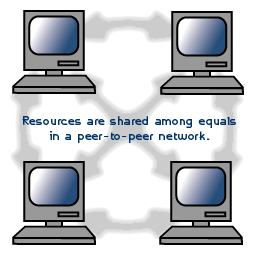
Peer-to-peer network operating systems allow users to share resources and files located on their computers and to access shared resources found on other computers. However, they do not have a file server or a centralized management source (See fig. 1). In a peer-to-peer network, all computers are considered equal; they all have the same abilities to use the resources available on the network. Peer-to-peer networks are designed primarily for small to medium local area networks. AppleShare and Windows for Workgroups are examples of programs that can function as peer-to-peer network operating systems.


Fig. 1. Peer-to-peer network

Advantages of a peer-to-peer network:

  • Less initial expense - No need for a dedicated server.
  • Setup - An operating system (such as Windows XP) already in place may only need to be reconfigured for peer-to-peer operations.

Disadvantages of a peer-to-peer network:

  • Decentralized - No central repository for files and applications.
  • Security - Does not provide the security available on a client/server network.

Client/Server

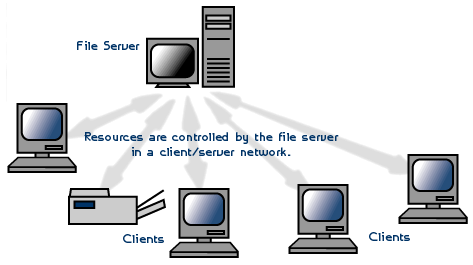
Client/server network operating systems allow the network to centralize functions and applications in one or more dedicated file servers (See fig. 2). The file servers become the heart of the system, providing access to resources and providing security. Individual workstations (clients) have access to the resources available on the file servers. The network operating system provides the mechanism to integrate all the components of the network and allow multiple users to simultaneously share the same resources irrespective of physical location. Novell Netware and Windows 2000 Server are examples of client/server network operating systems.


Fig. 2. Client/server network

Advantages of a client/server network:

  • Centralized - Resources and data security are controlled through the server.
  • Scalability - Any or all elements can be replaced individually as needs increase.
  • Flexibility - New technology can be easily integrated into system.
  • Interoperability - All components (client/network/server) work together.
  • Accessibility - Server can be accessed remotely and across multiple platforms.

Disadvantages of a client/server network:

  • Expense - Requires initial investment in dedicated server.
  • Maintenance - Large networks will require a staff to ensure efficient operation.
  • Dependence - When server goes down, operations will cease across the network.

Examples of network operating systems

The following list includes some of the more popular peer-to-peer and client/server network operating systems.